
Open the front panel of your furnace and look for the metal plate with the model and serial number. Somewhere in that serial is the year it was built, and for a lot of Las Vegas homes that year is a surprise, because the furnace came with the house and nobody has thought about it since. So how long do furnaces last, and does the number change in a city where the heat runs for three months and the air conditioner runs for eight?
The short answer is that a gas furnace is generally expected to serve somewhere between 15 and 20 years, with well-kept units going longer and neglected ones giving up sooner. The longer answer is that the number is a range for a reason, and the things that push a furnace to one end or the other are mostly things you control. (Electric furnaces, which heat with resistance coils and are common in homes without a gas line, have no burners or heat exchanger to wear out and often serve longer, though their blower and elements age the same way.)
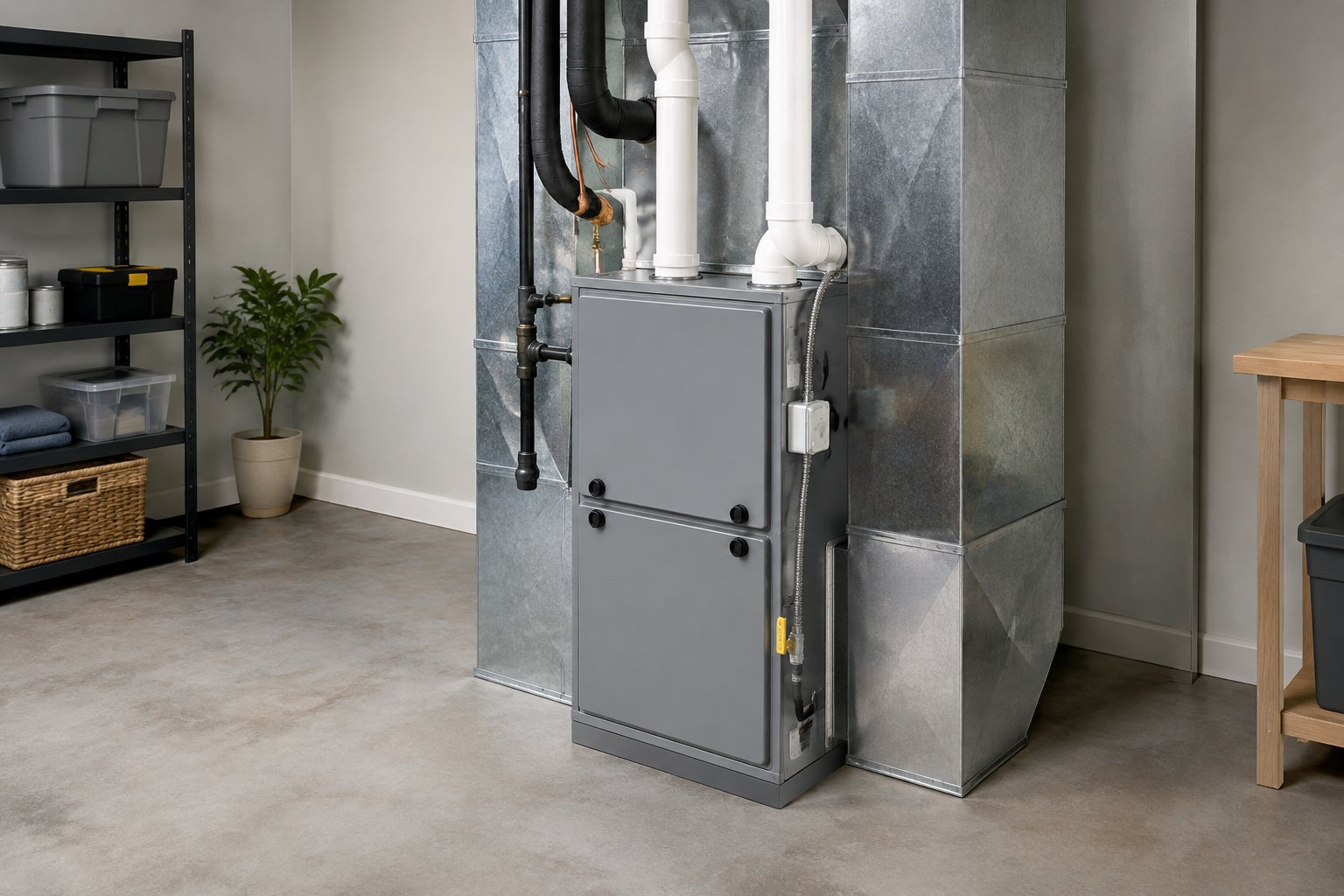
The heating season is short here, and that is the good news
A furnace in a cold-climate city might fire thousands of times a winter and run for months with barely a pause. In the Las Vegas Valley, real heating demand runs from roughly late November to late February, with a few cold snaps on either side. The burners, the igniter, the heat exchanger and the gas valve see a fraction of the cycles they would see elsewhere.
That matters, because most of the parts on the gas side of a furnace wear by the cycle. Every ignition heats the igniter, every flame cycle expands and contracts the heat exchanger, and every start puts a small stress on the gas valve. Fewer cycles mean slower wear, which is why a 20 year old furnace in Henderson can look in better shape than a 12 year old one in a snow belt.
The blower works all year, and that is the part of the furnace that does not get a break
Here is where the local story turns. In most Las Vegas homes the furnace and the air conditioner share the same indoor cabinet. The furnace's blower motor is what pushes cooled air through the house in July, and in a 110 degree summer that motor can run for most of the day, for months.
So while the burners rest, the blower, the control board, the capacitor and the motor bearings are putting in full-time hours. By the time a furnace is 12 to 15 years old, its blower motor has often done the work of a 25 year old furnace somewhere with a mild summer. That is why blower motor failures, failed run capacitors and tired control boards show up on relatively young furnaces here, and why "the furnace is fine, it only runs in winter" is a sentence that misleads a lot of homeowners.
Dust, attics and garages shorten a furnace's life in the valley
Three local conditions do most of the damage.
Dust is the first. Fine desert dust gets into every return, and a filter that goes unchanged for a summer loads up and starves the system of air. On the cooling side that strains the blower. On the heating side it makes the heat exchanger run hot, trips the high limit switch, and over years of overheating can crack the exchanger itself, which is the single failure that most often ends a furnace. Dust that gets past the filter coats the blower wheel, throwing it out of balance, and settles on the flame sensor and burners.
Installation location is the second. Furnaces in attics live in 140 degree air in summer, which cooks electronic boards and dries out wiring insulation. Furnaces in garages breathe dust, lawn chemicals and whatever else is stored next to them, and corrosive fumes from stored pool chemicals are hard on burners and exchangers.
Sizing is the third. Many homes in the valley have furnaces that are larger than the house needs, because the AC was sized for summer and the furnace came as a matched set. An oversized furnace heats the house fast, shuts off, and starts again a few minutes later. That short cycling multiplies ignition and expansion cycles, which is exactly the wear the short heating season was supposed to spare you.
The parts fail in a rough order, and the order tells you where you are
A furnace rarely dies all at once. It ages in stages, and knowing which stage you are in is more useful than the calendar.
In the first ten years, failures are mostly small: a hot surface igniter that cracks, a flame sensor that needs cleaning, a run capacitor on the blower, a pressure switch hose that splits. These are quick repairs and they do not say much about the furnace's remaining life.
From about year ten to fifteen, the bigger parts start to go. Blower motors fail, control boards develop faults, inducer motors get loud and seize, and gas valves stick. These are still repairs, but each one is a chance to ask what else is close behind.
Past fifteen, the conversation changes. Heat exchangers crack from years of expansion, rust appears on the burners, and the furnace struggles to hold the house at temperature on the coldest nights. A cracked heat exchanger is the point where repair stops being an option, because it allows combustion gases into the air stream and the unit has to be taken out of service. The Consumer Product Safety Commission urges a yearly professional inspection of fuel-burning heating systems for exactly this reason (cpsc.gov).
Habits that add years to a furnace in this climate
Most of what extends a furnace's life is boring, which is why it gets skipped.
Change the filter on a schedule that matches the dust, not the box. In this valley that often means monthly through summer and every two to three months in winter. Hold a filter up to a light once a month; if you cannot see through it, it is done.
Run the furnace for a test cycle on a mild afternoon in October. A problem that shows up on a 65 degree day is a repair; the same problem on the first cold night is an emergency.
Keep the area around the furnace clear, with nothing stored against it and nothing blocking the combustion air openings. In a garage, move the pool chemicals somewhere else.
Have the furnace serviced once a year, ideally in fall. A technician cleans the burners and flame sensor, checks the heat exchanger, tests the safety switches, measures the gas pressure and inspects the blower. Every Dwellness plan includes an HVAC maintenance plan, which takes the "I will get to it" out of the annual tune up. And because the furnace shares its cabinet with the AC, the post on how long AC units last in Las Vegas is the other half of this story.
The signals that a furnace is close to the end
Age alone does not retire a furnace. These do.
Repairs that come in pairs. A blower motor one winter, a control board the next, an inducer the year after. When the furnace needs a visit every season, the parts are reaching the end together.
Rooms that never warm up and a furnace that runs long cycles without catching up, especially when the filter is clean and the ducts are intact.
A yellow or flickering burner flame instead of a steady blue one, soot on the cabinet, or a burning or chemical smell that returns after the first cold night.
A carbon monoxide alarm that has ever sounded with the furnace running, or a technician who has flagged the heat exchanger. That one is not a warning sign; it is a decision.
The post on signs you need HVAC repair covers the earlier warnings, the ones that are still repairs.
Where a home warranty fits into a furnace's later years
The years when a furnace is most likely to need a blower motor, a control board or a gas valve are the same years when the builder's warranty and the manufacturer's parts warranty are long gone. That gap is what a home warranty is for. Wear and tear breakdowns are covered, and a furnace that has simply worn out after years of Las Vegas summers running the blower is the definition of wear and tear.
Heating is covered in every Dwellness plan, and there is no maintenance history required to buy one, so an older furnace that still runs is not disqualified by its age alone. Reporting a breakdown takes a few minutes on the Dwellness site, day or night, or a call to (702) 641-8888; from there a licensed local technician is assigned and the covered repair goes ahead. If the unit cannot be repaired, replacement is handled under the terms of the contract, with the technician's diagnosis deciding which way it goes. More than 85 percent of Dwellness claims are resolved on the first visit. What is not covered is a furnace that was already failing when the plan was bought, or damage from a repair someone attempted themselves, and the post on whether a home warranty covers a furnace goes into how pre-existing conditions are handled. The full list of covered heating breakdowns is on the heating home warranty page.
A furnace in Las Vegas gets an easy winter and a hard summer, and how long it lasts depends mostly on filters, airflow and whether anyone looks at it once a year. If yours is into its second decade, the practical move is to make sure the next failure is a service request rather than a scramble. Request a free quote at dwellness.house today, or call (702) 509-7007 if you would rather talk it through with someone local.