
There is a dark ring on the garage floor around the base of the tank, or a slow drip you can hear ticking onto the drain pan when the house is quiet. A water heater leaking is one of the few plumbing problems where the location of the water matters more than the amount. A puddle fed from the top of the tank is a very different story from a puddle fed from the bottom, and a few minutes with a flashlight and a paper towel will usually tell you which one you have.
Before you look closely, do two things. If the floor is wet and the heater is electric, do not stand in the water while touching the tank; switch off the water heater breaker first. If the heater is gas and you smell gas, leave the house and call Southwest Gas from outside. A leak itself is rarely dangerous, but water and electricity in a tight closet can be.
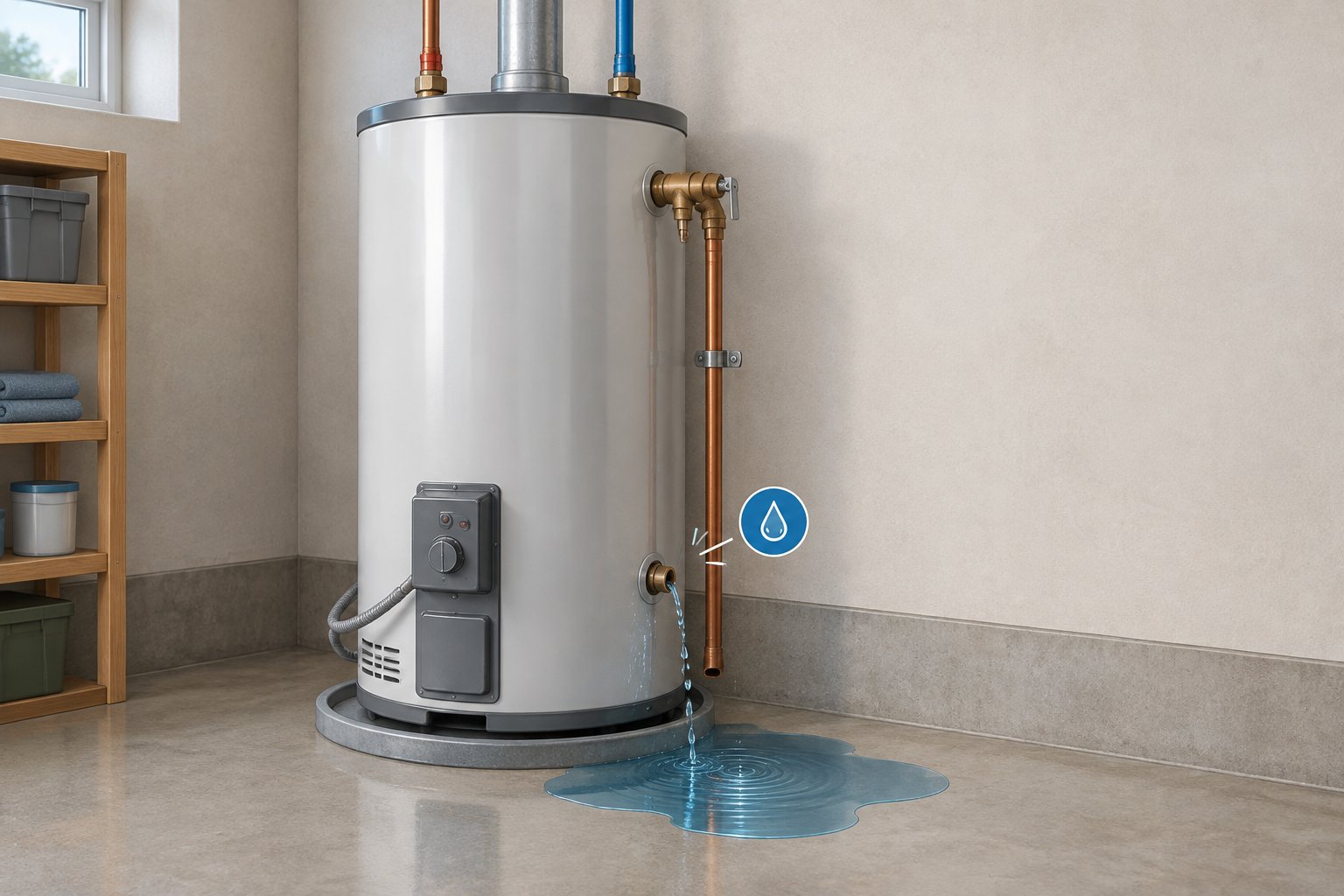
Dry everything, then watch where the first drop forms
Water runs downhill and along pipes, so a drip that starts at a fitting on top often ends up on the floor and looks like a bottom leak. Wipe the tank, the pipes above it, the valve on the side and the drain valve at the bottom with a towel. Lay dry paper towels on the floor around the base and under each fitting. Then wait fifteen minutes and see which towel gets wet first.
While you wait, note whether the leak is constant or only shows up at certain times. A puddle that appears only after a long shower or a laundry load points to pressure or temperature, not a hole. A puddle that grows steadily no matter what the house is doing points to a failed part or a failed tank.
Water heater leaking from the top: almost always a fitting
The top of the tank has the two water connections (cold in, hot out), often a pair of flexible lines, sometimes a shutoff valve, and on many Las Vegas units an inlet connection that has been crusted white by years of hard water. Leaks here are good news, relatively speaking. They are plumbing, not tank.
Run a dry finger along the underside of each connection. A damp nut on a flex line can sometimes be snugged a quarter turn. A corroded fitting, a cracked plastic nipple or a pinhole in a flex line needs replacing, which is a short job for a plumber. Hard water is a factor here more than most people realize. Mineral scale builds up inside the fittings and around the threads, and the Las Vegas hard water post explains why our water is so much harder on connections than water in most of the country.
One more top-of-tank source: on a gas unit, condensation can form on the cold flue and drip down the outside of the tank when the heater is working hard on a cold morning. It stops once the tank warms up. If the drip disappears within an hour of a heating cycle, that is all it was.
The relief valve leaks on purpose, until it does not
Partway down the side of the tank, or on top of some models, is a brass valve with a small lever and a pipe running down toward the floor. That is the temperature and pressure relief valve, usually called the TPR or T&P valve. Its job is to open and release water if the tank gets too hot or the pressure climbs too high. A few drops from the end of that pipe after a heating cycle can be normal.
A steady drip or a regular stream is not normal, and it means one of two things. Either the valve has worn out and no longer seals, or the pressure in the tank really is too high. In Las Vegas homes with a pressure regulator on the main line, a regulator that has failed is a common reason for a relief valve that keeps weeping. Closed plumbing systems without an expansion tank can do the same thing every time the heater runs.
Do not cap or plug a leaking relief valve. It is the one safety device on the tank, and a plugged valve on an overheating heater is how tanks rupture. Have a plumber test the pressure, replace the valve if it has failed, and add or replace an expansion tank if the system needs one.
Water heater leaking from the bottom: find out if it is the drain valve or the tank
Crouch down and look at the bottom of the tank. There is a small drain valve, usually plastic or brass with a hose thread, near the base. If the water is coming from that valve, you may be in luck. Drain valves get bumped, open slightly, or fail to reseal after someone has flushed the tank. A hose cap screwed onto the thread will stop a minor weep until a plumber can replace the valve.
If the drain valve is dry and the water is coming from the seam, from under the outer jacket, or from the burner compartment on a gas unit, the leak is from the tank itself. Steel tanks are glass lined inside, and once that lining is breached the steel rusts through. Sediment makes this happen faster here than almost anywhere: a thick layer of mineral sludge on the bottom of the tank traps heat against the steel, the bottom overheats, the lining cracks and corrosion gets in. A tank that has started leaking from the bottom does not get repaired. It gets replaced.
A leaking tank usually starts small, but it rarely stays small. If you see water from the tank body, shut the cold water supply valve on top of the heater, turn the gas control to Off or switch off the breaker, and make the call that day.
Rust, rumbling and warm water on the floor are the early warnings
Most tank failures announce themselves. Rusty or brown water from the hot tap, a rumbling or popping sound while the burner runs, water that is warm when you touch the puddle, and a heater well past its tenth birthday are all signs the tank is close. The post on how long hot water heaters last covers what shortens their life in this valley and what a typical lifespan looks like.
There is one part worth asking about if the tank is still sound: the anode rod. It is a sacrificial metal rod inside the tank that corrodes so the tank does not. In hard water it can be used up in a few years, and once it is gone the tank starts rusting from the inside. A plumber can check it during a service visit.
The decision on a leaking heater is mostly made by the location
Fitting on top, relief valve, drain valve: these are repairs, and a plumber handles them in a visit. Tank body: that is a replacement, and the rest of the conversation is about size, fuel and whether the new installation needs anything brought up to current code. Las Vegas has a lot of homes built in the same few years, and a lot of water heaters reaching the same age at the same time, so plumbers here see both ends of this daily.
The water heater replacement cost post walks through what goes into a replacement if it comes to that.
Where a home warranty picks this up
A water heater that leaks because a part has worn out, or because the tank has corroded through after years of normal use, is the kind of breakdown a home warranty exists for. Water heater coverage is included in all three Dwellness plans, from the Essential Plan up, and you do not need to produce maintenance records to buy a plan. When a leak shows up, you report it to Dwellness through the website at any time or by calling (702) 641-8888, a licensed local plumber is assigned, and 97 percent of Dwellness claims are approved.
The water heater home warranty page lists what a typical covered breakdown looks like. What a warranty does not do is cover a leak that was left to run for weeks, damage from a DIY repair, or a tank that was already failing before the plan started. Catching the leak early matters for the floor underneath the heater, too; the plumbing home warranty page covers the supply lines, valves and stoppages that often sit right next to the tank.
A wet floor under the water heater is never nothing, but it is usually not a disaster either. Dry it, watch it, find the source, and act on what you see. If the answer is a worn part or a tired tank, a plan that already covers the water heater turns a stressful afternoon into a service request. Dwellness has handled those for Las Vegas homeowners since 1986, so request a free quote at dwellness.house or call (702) 509-7007 and have the plan in place before the next drip.