
This is the third time this week you have crouched in front of the furnace with a long lighter, held the knob down, counted to sixty, and watched the little blue flame hold. And the third time that by morning the house is cold again and the flame is gone. When a pilot light keeps going out, relighting it is treating the symptom. Something is telling the gas valve to shut the pilot off, and that something is almost always one of four parts: the thermocouple, the pilot burner itself, the air around it, or the gas supply behind it.
Standing pilots are mostly found on furnaces built before the mid 1990s, on many water heaters, and on gas fireplaces. Las Vegas still has plenty of older furnaces in neighborhoods built in the 70s and 80s, and in garages and closets where they get little attention until they stop. This article focuses on the furnace, with notes on the others where they differ.
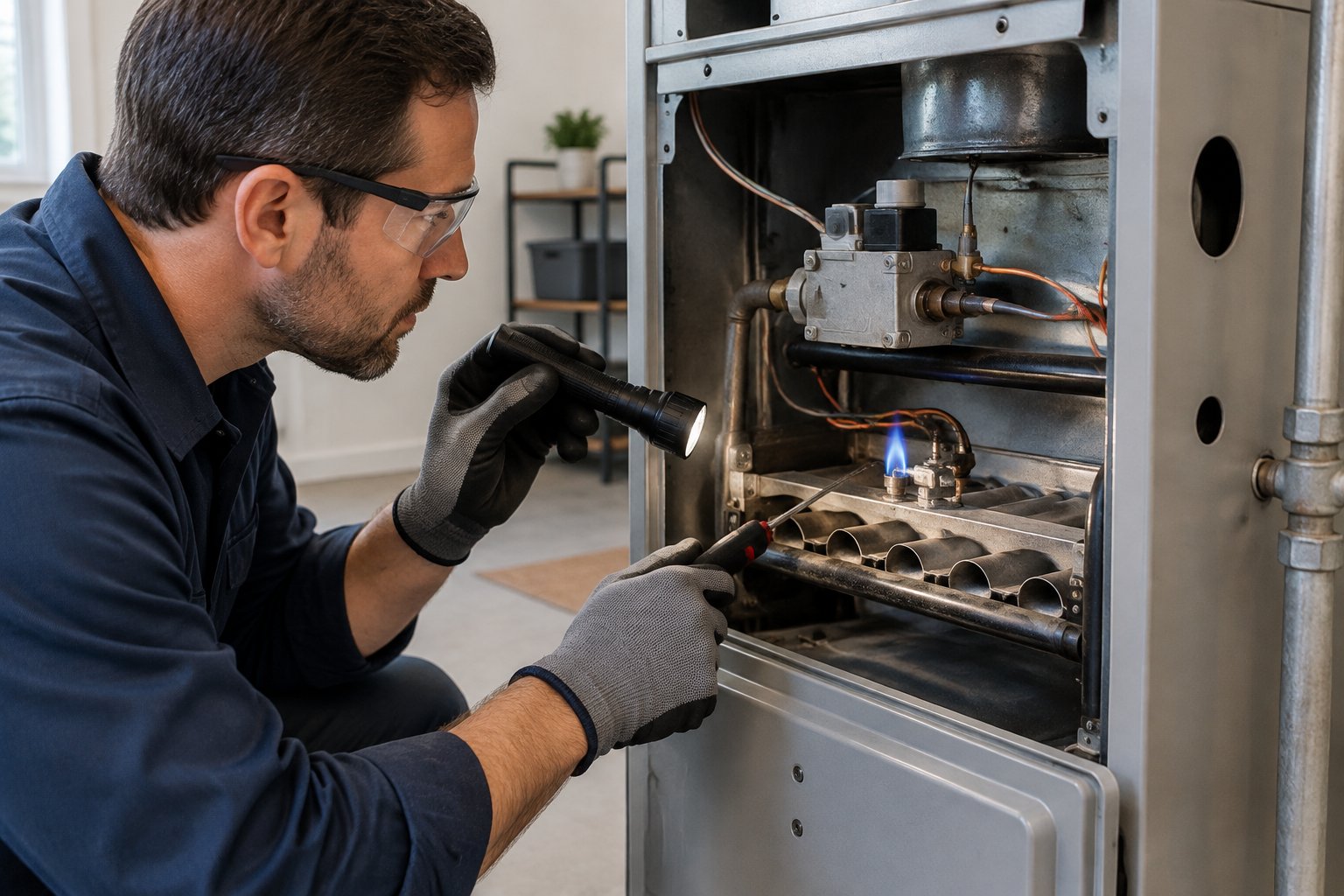
The pilot and the thermocouple are a team, and the thermocouple usually quits first
A standing pilot does two jobs. It lights the main burners when the thermostat calls for heat, and it keeps a small metal probe hot. That probe is the thermocouple. Sitting in the pilot flame, it generates a tiny electrical current that holds the gas valve's safety circuit open. If the flame goes out, the probe cools, the current stops, and the valve closes the pilot gas within seconds. This is the safety system that stops raw gas from flowing into your home.
Which means a pilot that lights, holds while you press the knob, and dies the moment you let go is not a flame problem. It is the thermocouple failing to tell the valve the flame is there. Thermocouples weaken with age, get coated with soot and oxidation, and can shift so that the tip is no longer in the hottest part of the flame. That last one is common in furnaces that have been bumped during a filter change.
Look at the pilot while it burns. The thermocouple tip should sit in the upper third of the flame, surrounded by blue. If the flame only licks at it, or the probe is black with soot, that is the problem. Replacing a thermocouple is a routine job that nonetheless happens inches from a gas valve, and it is where most homeowners should hand off to a technician. A thermocouple that is cross-threaded or overtightened will not seal, and the symptom you are trying to fix comes straight back.
A weak, yellow or wandering pilot flame points to the pilot burner itself
A healthy pilot flame is steady, mostly blue, and shaped like a small cone that reaches the thermocouple. A flame that is yellow, flickering, split in two, or so small it barely clears the pilot tube is burning badly, and a bad flame does not keep the thermocouple hot enough.
The usual reason in this valley is dust. The pilot orifice is a tiny opening, and a season's worth of fine desert dust plus a little rust can partly block it. The flame starves, turns yellow and lazy, and the thermocouple cools until the valve shuts the gas. Spiders also like pilot tubes, and a web across the opening does the same thing.
Cleaning a pilot orifice means shutting off the gas, removing the pilot assembly and clearing the opening with compressed air or a soft brush, never with a wire or a pin, which enlarges the hole and changes how the flame burns. Because this involves disconnecting a gas fitting, it is a technician's task on a furnace. On a gas fireplace, the same symptom often comes from dust and decorative embers piled over the pilot, and simply clearing the area around it can help.
A draft can blow the pilot out even when every part is fine
If the pilot stays lit for hours and then goes out at random, especially on windy nights, think about moving air rather than failing parts.
Furnaces in garages and utility closets live near doors, vents and gaps. A garage door opening, a dryer running in the next room, a bathroom exhaust fan, or a strong downdraft through the flue on a gusty evening can all blow a small flame sideways off the thermocouple. In older homes, a furnace closet that was never meant to be sealed gets a weatherstripped door added years later, and then the pilot is starved of combustion air and smothers itself.
Watch the flame with the room as it normally is. If it leans or dances, find the source. Then check the flue. A vent cap that has blown off, a bird's nest, or a chimney that shares a flue with a water heater can all create a downdraft that pushes air back down onto the pilot. Flue problems are also a carbon monoxide risk, so a pilot that goes out only in windy weather deserves an inspection rather than a shrug.
Gas supply and the gas valve are the last stops, and both belong to a professional
A pilot that burns smaller than it used to, or sputters when other gas appliances come on, may not be getting enough gas. Check whether the water heater and stove are behaving normally. If all of them are weak at once, the problem is upstream, possibly the regulator at the meter, and the call goes to Southwest Gas.
If the pilot and thermocouple have both been replaced and the flame still will not hold, the gas control valve itself is the likely cause. The magnet inside the valve that the thermocouple energizes can weaken, and a valve that cannot hold the pilot circuit open will drop the flame no matter how good the thermocouple is. Gas valves are not repaired; they are replaced, and only by someone licensed to work on gas.
Relighting a pilot without taking a risk
Every furnace with a standing pilot has lighting instructions on a label inside the front panel. Follow those, not a generic video, because the sequence differs between models. The steps that are common to nearly all of them: turn the gas control to Off and wait at least five minutes so any gas that collected can clear, turn the control to Pilot, press and hold the knob while lighting the pilot, keep holding for 30 to 60 seconds so the thermocouple heats, then release and turn to On.
Two rules override everything. If you smell gas before, during or after relighting, stop, do not touch any switch, leave the house and call Southwest Gas or 911 from outside. And if the pilot will not hold after two attempts, stop trying. Repeated attempts put unburned gas into the burner compartment, and a pilot that fails twice is telling you the fix is a part, not a lighter.
Water heater pilots follow the same logic, and many newer water heaters have a sealed burner compartment with a built-in igniter button rather than an open flame. Those are safer to relight but harder to diagnose, and a pilot that keeps failing on one of those is nearly always a thermocouple or thermopile.
When the pilot problem is really a replacement conversation
A furnace with a standing pilot is, by definition, an older furnace. If the pilot problem comes alongside rust on the burners, a heat exchanger that has never been inspected, or a unit that struggles to keep the house warm on cold nights, the pilot is a symptom of age rather than the whole story. That does not mean the furnace is done, but it is worth having a technician look at the whole unit while they are there for the thermocouple, and the post on signs you need HVAC repair lists what else to watch for.
Where a home warranty fits in with a failing pilot
A thermocouple that has worn out, a pilot assembly that has corroded, and a gas valve that can no longer hold are all parts that fail through normal use, and normal wear and tear is exactly what a home warranty is written to cover. Heating systems are included in each of the three Dwellness plans, and the same plans cover the water heater, so a stubborn pilot on either appliance goes through the same process: file a service request online, at any hour, or call (702) 641-8888, and a licensed local technician is dispatched to diagnose it. More than 85 percent of Dwellness claims are resolved on the first visit, which for a thermocouple is the normal outcome.
A warranty is not the answer to a pilot blown out by a draft you can fix with a door sweep, and damage caused by someone bending the thermocouple with pliers is the kind of DIY damage a contract can exclude. The heating home warranty page describes covered heating breakdowns, the water heater coverage page does the same for the tank in the garage, and the post on whether a home warranty covers a furnace explains how an older unit is treated.
A pilot that keeps going out is a small flame carrying a big safety job, and the parts that make it work are simple to replace but wrong to improvise on. Relight it once, following the label. If it fails again, it is time for a part, and if the heating system is already covered, that is a service request and a short visit. To see what coverage would look like for your home, request a free quote at dwellness.house, or call (702) 509-7007 during office hours.