
There is a puddle spreading across the garage floor, the cardboard boxes nearest the water heater have gone soft at the bottom, and the drywall behind the tank has a dark tide mark creeping upward. Your first thought after “turn off the water” is probably “does homeowners insurance cover a water heater,” and the honest answer is that it depends on which part of this mess you are asking about. Insurance looks at a water heater failure as two separate events: the tank that broke, and the damage the water did on its way out. It treats them very differently.
Knowing that split before you call anyone changes what you say, what you photograph and which policy you reach for.
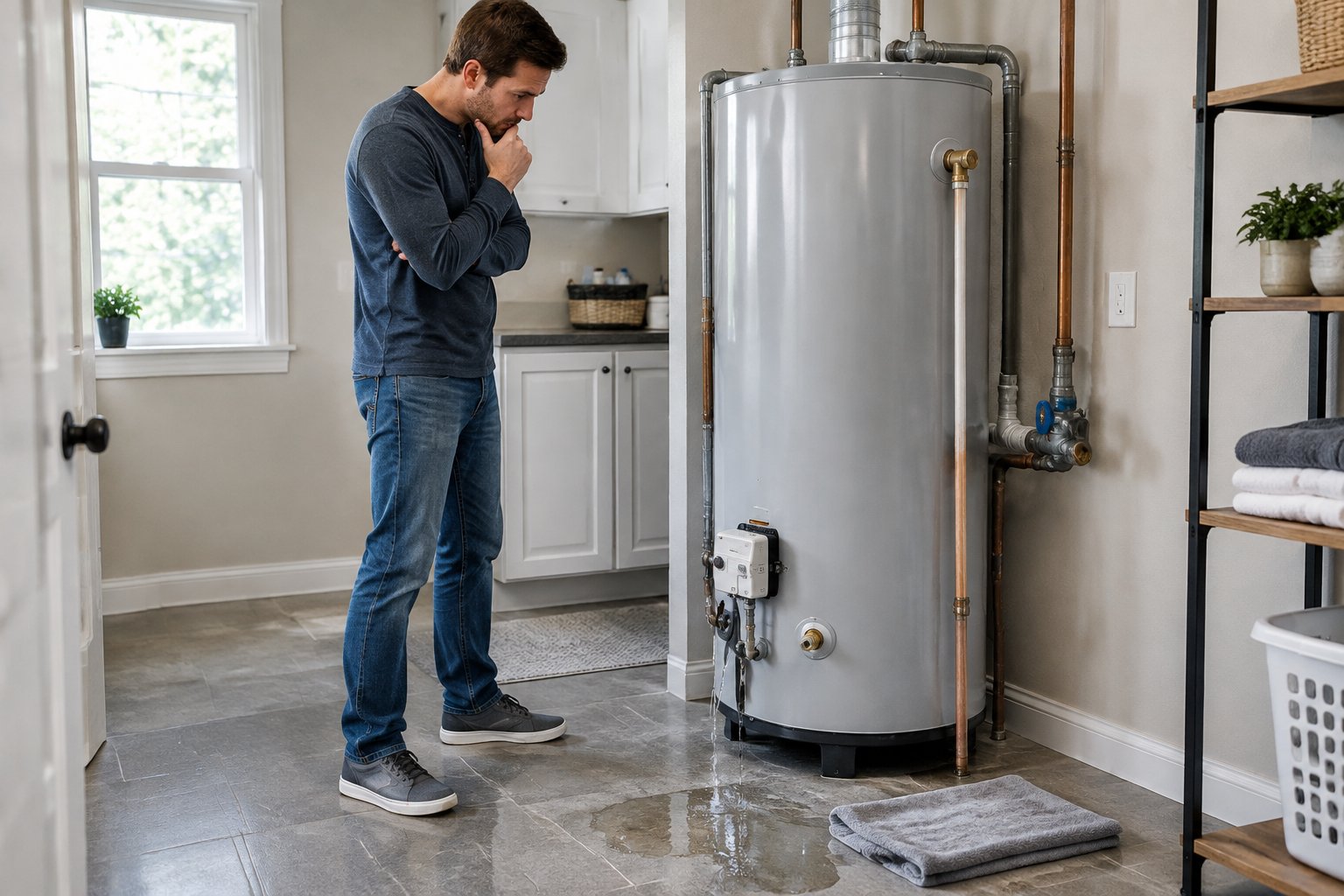
Insurance pays for the water damage, not the heater that caused it
A standard homeowners policy is built around sudden, accidental events. A tank that splits open on a Tuesday afternoon and dumps 40 gallons across the floor is exactly that kind of event, so the resulting damage to flooring, drywall, baseboards, cabinets and belongings is usually a covered loss, subject to your deductible.
The tank itself is a different story. Nearly every homeowners policy carves out the source of the water. A special-form homeowners policy filed with the Nevada Division of Insurance spells it out: the policy covers "discharge or overflow of water or steam from within a plumbing, heating, air conditioning or automatic fire protective sprinkler system or from within a household appliance," but states plainly, "We do not cover loss to the system or appliance from which this water escaped" (docs.nv.gov). In plain terms, the insurer may pay to replace the warped laminate and the stained drywall, and you pay for the new water heater.
That single clause answers most "homeowners insurance water heater leak" questions. The leak's consequences can be a claim. The leaking appliance is not.
Wear, rust and corrosion are excluded on purpose
The second thing a policy does is exclude the way most water heaters actually die. Tanks fail from the inside out. The glass lining cracks, the steel beneath it rusts, the anode rod that was supposed to sacrifice itself has long since dissolved, and one day the bottom lets go. Insurers call that wear and tear, deterioration, rust or corrosion, and every one of those words appears on the exclusion list of the same Nevada policy form, along with "mechanical breakdown, latent defect, inherent vice."
So a water heater that simply reached the end of its life is not an insured event. Some insurers sell an optional equipment breakdown endorsement that extends coverage to mechanical failures; if your policy has one, it is worth reading, but it is an add-on, not the standard form. The policy will still generally cover the water damage that results, because the same form adds that if those excluded causes "cause water damage which is not otherwise excluded, we cover the resulting water damage." The rusted tank is yours to replace. The ruined floor may still be theirs to repair.
A slow drip is the leak insurance is least likely to pay for
The exclusion that catches the most people is the one about time. Policies draw a line between a sudden discharge and a slow seep. The Nevada form excludes "constant or repeated seepage or leakage of water or steam over a period of 14 days or more" from plumbing systems and household appliances. If the drip pan under the heater has been collecting water for a month, the baseboard has been swelling for weeks and the mold behind it is already established, an adjuster will likely treat that as neglected maintenance rather than an accident.
This is why the moment you notice moisture at the base of a tank matters so much. A leak you act on the day you see it is a sudden event. The same leak ignored until spring becomes a long-term maintenance problem, and the longer it runs, the less of the damage insurance tends to accept. In a Las Vegas garage, where the tank often sits on a stand against an exterior wall and nobody looks at it from one filter change to the next, that gap can stretch for months without anyone noticing.
The scenarios, sorted by who pays
Picture four different mornings and how each one usually shakes out.
The tank bursts overnight and floods the laundry room and the hallway carpet. Insurance typically covers the cleanup, the drying, the flooring and the drywall, after your deductible. The water heater is on you.
The tank has been weeping from a seam for weeks and you only noticed when the smell got bad. The water heater is on you, and a meaningful share of the damage may be denied under the seepage exclusion, especially anything involving mold.
The heater stops making hot water, no leak, no flood. Insurance is not involved at all. Nothing was damaged except the appliance, and the appliance is excluded. This is the most common water heater failure there is, and it is a pure repair or replacement question.
A pressure relief valve dumps scalding water across a finished basement or a downstairs closet because a thermostat stuck. The sudden damage is likely covered. The valve, the thermostat and the heater are not.
Notice the pattern. Insurance shows up when water gets loose quickly and ruins something else. It steps back from the heater itself every single time.
A home warranty is built for the part insurance steps back from
That gap, the appliance itself, is what a home warranty exists to cover. A warranty is a service contract on the systems and appliances in the house, and it pays for repair or replacement when one of them fails from normal wear and tear. Rust, a failed heating element, a dead thermocouple, a gas valve that will not open, a tank that has corroded through after a decade of hard water: those are the failures a warranty is written around, and they are exactly the failures a homeowners policy names as exclusions. The post on home warranty versus home insurance goes through the two documents side by side if you want the full comparison.
At Dwellness, the water heater sits inside the Essential Plan, the entry-level option, so it is covered on every plan. Buying coverage does not require maintenance records for the tank, which matters for a house you just closed on. When the heater fails, you file a service request through the claims page at any hour or call (702) 641-8888, a licensed local plumber is dispatched, and the covered breakdown is repaired or the unit is replaced under the terms of the contract. The water heater home warranty page lists what a covered breakdown looks like, and the post on whether a home warranty covers water heater replacement walks through what happens when the tank is beyond repair.
A warranty has its own limits. It does not pay to dry out the carpet or replace the drywall; that is the insurance side. It does not cover a problem that existed before the contract started, damage from a DIY repair, or a tank that failed because a known leak was left to run. The two products meet at the base of the tank, and together they cover both halves of the morning described at the top of this article.
What to do in the first hour, whichever policy you end up calling
Turn off the cold water supply valve above the heater. On a gas unit, turn the gas control knob to Off. On an electric unit, switch off the water heater breaker at the panel before anything else, because a tank that has drained can burn out its elements in minutes.
Then take photographs before you clean anything: the tank, the puddle, the water line on the drywall, the ruined boxes, the date on the tank's label. Insurance adjusters and warranty technicians both want to see the condition the failure was found in, and the label tells both of them how old the unit is. Move what you can off the wet floor, open the garage door or run a fan to start drying, and call your insurer the same day if there is damage to the structure or your belongings. The faster the timeline, the more clearly it reads as sudden.
Water heaters in this valley work hard. Our water is very hard, the tanks scale up and rust from the inside, and the post on how long hot water heaters last explains why a tank here often does not reach the age it would somewhere with softer water. If yours is past ten years old, the question is not whether it will fail but which morning.
Insurance will handle the floor. A plan that already covers the water heater handles the tank, and it turns a scramble for a plumber into a single service request. Dwellness has been covering Las Vegas homes since 1986, approves 97 percent of claims, and resolves more than 85 percent of them on the initial visit. Get started today by requesting a free quote at dwellness.house or calling (702) 509-7007.