
Most water heaters in Las Vegas are never touched between the day they are installed and the day they quit. They sit in a garage that hits 120 degrees in August, fed by some of the hardest municipal water in the country, and they get asked to work every single day. Water heater maintenance here is not fussy or complicated, but skipping it has a specific consequence: the tank fills with mineral sediment, runs hotter and longer than it should, and dies years before it had to.
The Las Vegas Valley Water District’s own 2026 water quality summary lists total hardness at 280 parts per million, or 16 grains per gallon. The U.S. Geological Survey classes anything over 180 milligrams per liter as very hard, so every gallon your heater warms drops a little more calcium and magnesium onto the bottom of the tank. That single fact drives almost everything on this checklist.
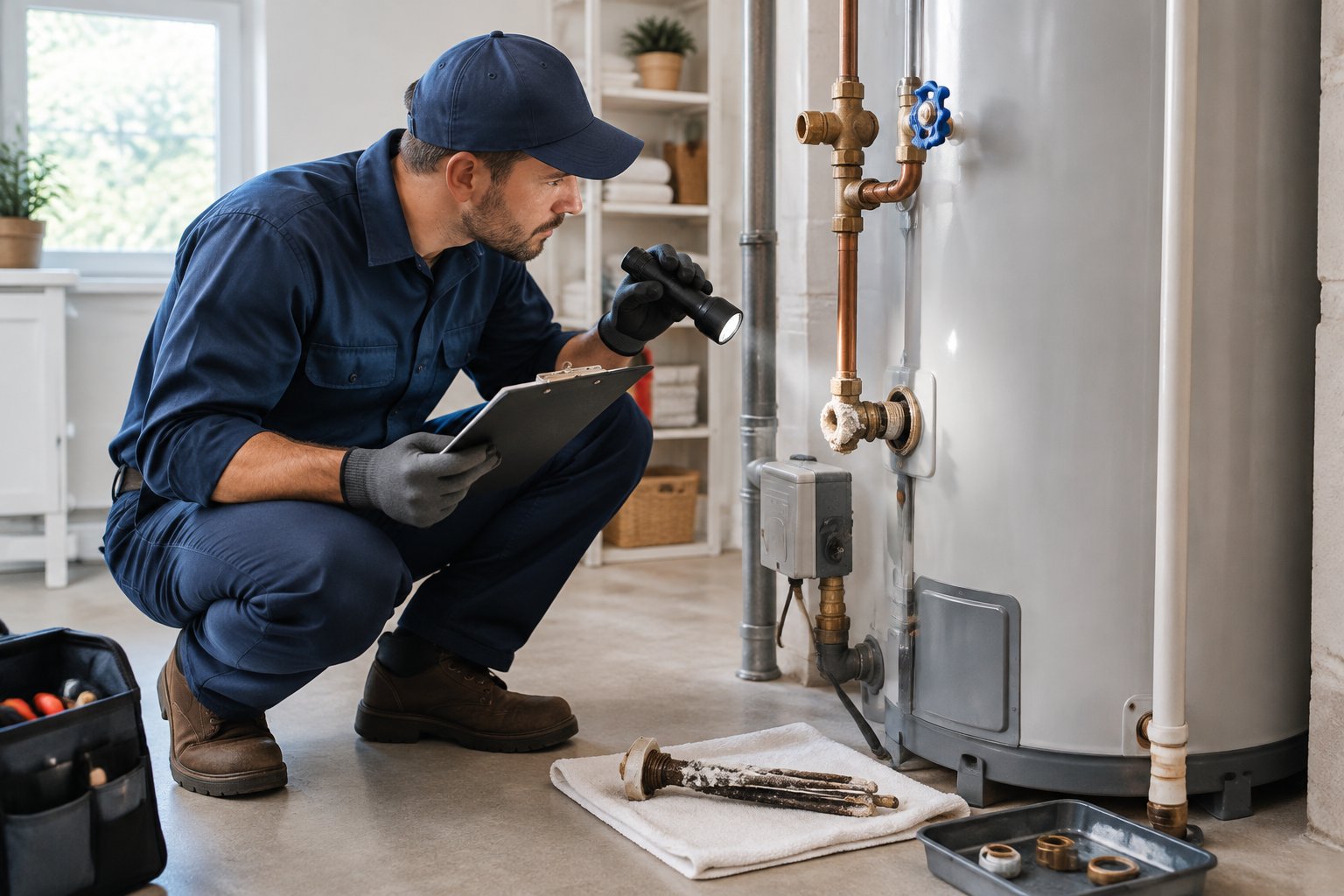
Know which jobs are yours and which belong to a plumber
A handful of water heater tasks are genuinely homeowner work: checking the temperature, looking for leaks, testing the relief valve, and draining a few gallons from the tank. Replacing an anode rod, replacing a relief valve, descaling a tankless unit and the first complete drain of a tank that has been neglected for years are better left to a plumber, mostly because of what can go wrong (a drain valve that will not close, a rod seized in the tank, a relief valve that will not reseat).
Gas heaters add one rule. Before you do anything that involves draining the tank, turn the gas control to the Pilot or Vacation setting so the burner cannot fire on an empty tank. On an electric heater, switch off the breaker first; an element that heats with no water around it burns out in seconds.
Drain a few gallons every few months to keep sediment moving
This is the single most useful habit for a Las Vegas tank, and it takes ten minutes. Connect a garden hose to the drain valve at the base of the heater, run the other end to a floor drain, the driveway or a bucket, and open the valve for a minute or two. You are not emptying the tank. You are pulling the loose sediment off the bottom before it packs into a hard layer. Close the valve, remove the hose, and check that the valve has fully resealed.
If the water comes out milky or carries sandy grit, that is the sediment you are trying to stay ahead of. If the water runs clear and you have been doing this for a while, you can stretch the interval. The Las Vegas hard water post goes deeper into what that grit is and what it does to every water-using appliance in the house.
Do a full flush once a year, with one caution
A full flush means shutting off the cold supply, opening a hot faucet somewhere in the house to let air in, and draining the whole tank through the hose. Then open the cold supply in short bursts with the drain still open, to stir and push out the sediment that a gentle drain leaves behind. When the water runs clear, close the drain, refill the tank until water runs steadily from the open hot faucet, and only then restore gas or power.
The caution is this. If a tank has gone five or ten years without a flush, the sediment can be inches deep and the plastic drain valve may be the weak point. A valve that clogs with grit and will not close, or snaps when you try, turns a maintenance job into an emergency. On an old, never-flushed heater, let a plumber do the first one.
Check the anode rod before the tank starts rusting from the inside
Inside the tank is a long metal rod, usually magnesium or aluminum, threaded into the top. It exists to corrode. Water attacks the rod instead of the steel tank, and as long as there is rod left, the tank stays protected. In our water a rod can be mostly consumed in a few years, and once it is gone the glass-lined steel starts to rust.
Checking the rod means loosening a large hex head on top of the tank and lifting the rod out, which is a plumber's job on most units because the fitting is tight, the clearance above the heater is often short, and a rod that breaks off inside the tank is a problem. Ask for an anode inspection at the three to four year mark and replace it when it is down to bare wire. A new rod on a sound tank is one of the cheapest ways to add years to a water heater, and it is the one maintenance item almost nobody does.
Test the relief valve once a year and know what a bad result looks like
The temperature and pressure relief valve is the brass valve with a lever on the top or side of the tank. Put a bucket under the discharge pipe, lift the lever for a second or two, and let it snap back. Water should rush out while the lever is up and stop completely when it drops.
If nothing comes out, the valve is seized and needs replacing. If it keeps dripping after you release it, the seat is fouled and it also needs replacing. Either way, that is a plumber call, and it is not one to postpone. The relief valve is the only thing standing between a thermostat failure and a ruptured tank.
Set the temperature where it protects the tank and the people in the house
The U.S. Department of Energy suggests turning the thermostat down to 120 degrees as a sensible setting for most homes. There are two reasons that number works well here. Scalding risk drops sharply below 120, which matters in homes with kids or older relatives. And mineral scale forms faster at higher temperatures, so a tank running at 140 is building sediment faster than one at 120.
On a gas heater the dial is on the gas control at the bottom. On an electric heater the thermostats are behind the two access panels, and the breaker must be off before you remove them. If the hot water at the tap feels much hotter than it used to, the thermostat may be failing rather than mis-set.
Walk around the heater and look at four things
Once a season, spend a minute looking rather than doing. Check the floor and the drain pan for moisture. Look at the fittings on top for white crust or green corrosion. On a gas unit, look at the flue pipe where it meets the top of the tank and confirm it is still connected and not rusted, and glance through the burner window for a steady blue flame rather than yellow. On an electric unit, listen for a hiss or sizzle while it heats, which usually means an element caked in scale.
Write the installation date on the tank with a marker if it is not on the label. The post on how long hot water heaters last explains why that date matters more than how the tank looks from the outside.
Tankless units need descaling, not flushing
A tankless heater has no tank to fill with sediment, but it has a heat exchanger with narrow passages that scale closes up over time. The symptom is hot water that cycles hot and cold, a drop in flow, or an error code. Descaling means isolating the unit with its service valves and circulating a descaling solution through it with a small pump for an hour or so. Once a year is the usual interval here, and more often if the unit has no softener ahead of it. Most homeowners have a plumber do it, though the service valves make it a reasonable DIY job once you have watched it done.
Also clean the small inlet water filter screen a couple of times a year. It catches grit before the heat exchanger and clogs faster in this valley than the manual expects. On a unit mounted in the garage, check that the air intake and vent screens are free of dust and cobwebs too; desert dust blocks them sooner than you would expect.
Maintenance and a home warranty work together, not instead of each other
Regular care keeps the tank running longer, but it does not stop a thermostat from failing or a gas valve from giving up. That is the part a home warranty handles. Every Dwellness plan includes water heater coverage for breakdowns from normal wear and tear, and the Essential Plan also includes a plumbing maintenance plan, so routine attention to the system is built into the coverage rather than something you have to chase. You are not asked for maintenance records to buy a plan, and when something does fail, more than 85 percent of Dwellness claims are resolved on the first visit by a licensed local contractor.
The water heater home warranty page describes what is typically covered, and the plumbing maintenance tips post covers the rest of the system that feeds the heater.
A water heater in Las Vegas has a harder job than one almost anywhere else, and a yearly hour of attention is what separates a tank that makes it past a decade from one that leaks at seven. Do the easy items yourself, hand the anode and the first big flush to a plumber, and let a home warranty cover the parts that wear out anyway. Dwellness has been doing that for Las Vegas homeowners since 1986; you can request a free quote at dwellness.house or call (702) 509-7007.