
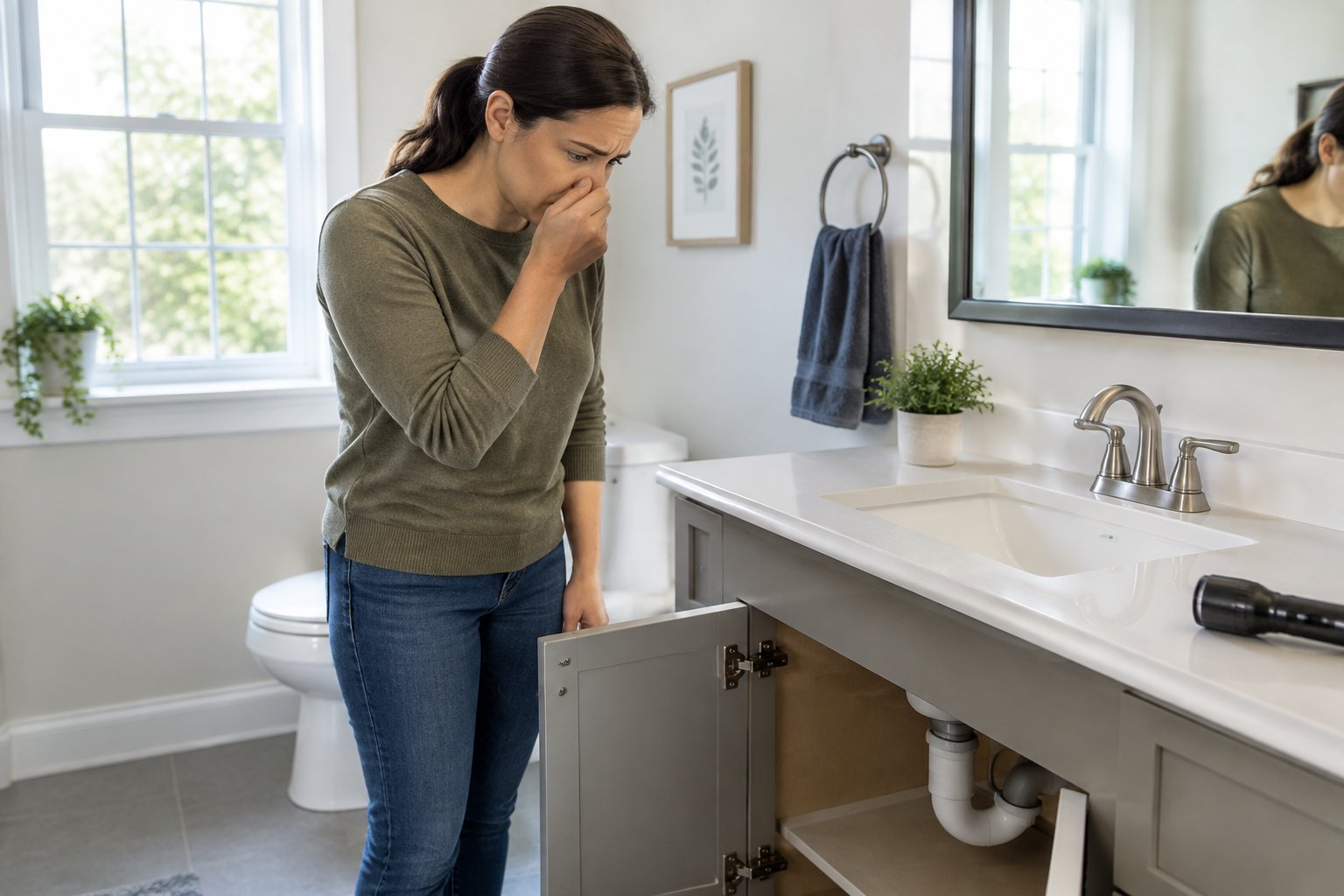
You walk in from a week away, drop the bags, and the hallway smells like a sewer. It is strongest near the guest bathroom nobody has used since the in-laws visited, and it fades once you open a window, then creeps back by evening. A sewage smell in a house is almost never coming from the sewer itself. It is coming from a gap somewhere between the sewer and your living space that is supposed to be sealed and is not. Find the gap and the smell goes with it.
The way to find it is by room and by timing. Where is it strongest, and does it come and go with something you do, such as running the washing machine, flushing a particular toilet, or the house sitting empty? Those two clues point at one of six sources.
First, the safety line
Sewer gas is mostly methane and hydrogen sulfide, the rotten egg smell. At the concentrations that drift out of a dry trap it is unpleasant and not much more. At higher concentrations, in a closed space, it is a different matter: hydrogen sulfide can cause headaches, nausea and dizziness, and methane is flammable. If the smell is strong enough to sting, if anyone feels lightheaded, or if you also smell natural gas (which has its own added odor and is a separate emergency), get people out, open doors, and call for help from outside. A faint smell that comes and goes is a plumbing puzzle. An overpowering one is not something to investigate yourself.
Source one: a dried-out trap, the most common cause in Las Vegas
Every drain in the house has a U-shaped bend under it that holds a few inches of water. That water is the seal. Sewer gas on one side, your bathroom on the other, and the water plug in between. If the water evaporates, the seal is gone and the drain becomes an open pipe to the sewer.
In a city where summer humidity drops into single digits and indoor air is dry year round, a trap that is not refilled can evaporate in a few weeks. That is why the smell so often lives in the guest bathroom, the shower in the spare bath that is used twice a year, the laundry room floor drain, the utility sink in the garage, or a basement-style floor drain in a mechanical closet. Run water into every drain in the house for thirty seconds, including the ones you never use, and flush every toilet. If the smell disappears within a day, that was it.
To keep it from coming back, run the unused fixtures once a month, or pour a cup of water down each neglected floor drain. A tablespoon of mineral oil on top of the water in a floor drain slows evaporation for months.
Source two: a toilet that rocks, or a wax ring that has failed
If the smell is strongest right at one toilet, and especially if the toilet moves even slightly when you push on it, the wax ring that seals the base to the drain flange has failed. Sewer gas leaks around the base instead of going down the pipe, and so can water, which shows up as discoloration or a spongy feel in the floor around the toilet. A loose toilet is also a sign the flange bolts have corroded or the flange itself has cracked.
This is a reseat-and-reseal job: pull the toilet, scrape the old wax, inspect the flange, set a new ring and bolt it down. It is within reach of a confident homeowner but it is heavy, awkward work, and a cracked flange turns it into a plumber's job. Do not try to fix a rocking toilet by caulking the base; that traps the leak under the floor.
Source three: a blocked or broken vent stack
Your drains need air behind them to flow, and that air comes from vent pipes that run up through the roof. When a vent is blocked, by a bird's nest, leaves, a dead rodent or in winter by frost, the drains try to pull air from the nearest trap instead. They gurgle, they drain slowly, and they suck the water seal right out of the trap, which puts you back at source one but with a cause that refilling will not fix.
The signs are gurgling at a sink when a nearby toilet flushes, a drain that burps air bubbles, and a smell that comes back a day or two after you refill the traps. A plumber can clear a vent from the roof with a cable or a hose; this is not a job to do yourself from a ladder on a tile roof. If the vent pipe has separated inside a wall or the attic, which happens in older homes and in homes that have had remodeling work, the smell may be strongest in a bedroom or hallway with no plumbing at all.
Source four: the washing machine standpipe and the laundry room
The laundry room has three suspects. The standpipe the washer drains into has its own trap, and if the washer has not run in a while, it dries out like any other. If the drain hose is pushed too far down the standpipe, it can siphon the trap dry every cycle. And the washer itself can hold stagnant water and lint in the drain pump, which smells like sewage even though it has nothing to do with the sewer. Running an empty hot cycle with a washer cleaner, pulling the hose up so only a few inches sit in the standpipe, and running water into any floor drain in the room usually settles all three.
Source five: biofilm in the drain, which smells like sewage but is not
Sometimes the smell is not sewer gas at all. It is the slimy layer of bacteria, hair, soap and food residue coating the inside of a drain, especially a bathroom sink with a pop-up stopper or a kitchen sink with a disposal. Lean over the drain and sniff; if the smell is in the drain itself and not in the room generally, that is the answer. Pull the stopper and clean it, scrub the overflow opening in the sink with a bottle brush, and flush with hot water and dish soap. An enzyme drain treatment keeps it from returning.
The hot water heater has its own version. If the smell is only when hot water runs, and only at the tap, it is sulfur bacteria reacting with the anode rod in the tank, not sewer gas. A plumber can flush the tank and change the rod type.
Source six: a main line or sewer problem, which is the one that needs a plumber now
If the smell is everywhere, if more than one fixture is slow or gurgling, if water or worse backs up into a shower or tub when a toilet flushes, or if there is a wet, foul patch in the yard over the sewer line, the problem is downstream of the house. A partial stoppage in the main drain or a broken sewer lateral lets gas and waste push back toward the lowest fixtures. In older Las Vegas neighborhoods, roots in clay pipe and deteriorated cast iron are the usual story. In newer homes, a construction debris blockage or a belly in the line can do the same.
Stop running water in the house if anything is backing up, because every flush adds to what comes back, and call a plumber. A main line stoppage is cleared with a long cable or a jetter, and a camera inspection tells you whether the pipe itself is damaged. The post on home warranty sewer line coverage explains how that side of the problem is handled.
Homes with a bathroom below the level of the sewer, which is uncommon here but exists in some custom and hillside builds, have a sewage ejector pump. A failed pump or a bad lid seal on its basin produces a strong smell in that part of the house, and the sewage ejector pump coverage page covers that specific equipment as an add-on.
Where a home warranty fits when the fix is more than refilling a trap
Refilling traps, cleaning a stopper and fixing a washer hose are chores. A stoppage that needs cabling or a drain line that has stopped flowing is a plumbing repair, and plumbing stoppages are covered in every Dwellness plan from the Essential Plan up. A toilet that needs resetting because the flange has failed is also a plumber's job; check your contract for how toilet and seal repairs are treated. The drain cleaning home warranty page describes what a stoppage claim typically includes, and the plumbing home warranty page covers the system as a whole.
When a covered part gives out, report it on the Dwellness site, day or night, or by calling (702) 641-8888; a licensed local plumber takes it from there, and your only cost at the door is the per-trade service fee. Dwellness has served Las Vegas homeowners since 1986 and approves 97 percent of claims. The contract does set limits: problems caused by foreign objects, damage from chemical cleaners, and conditions that existed before coverage began can fall outside it, and the exterior sewer line beyond the house is handled differently from the plumbing inside. The plumbing maintenance tips post has the monthly habits that keep most of these smells from ever starting.
Nine times out of ten, a sewer smell in a Las Vegas house is a dry trap in a room nobody uses, and thirty seconds of running water fixes it. The tenth time is a loose toilet, a blocked vent or a main line that is telling you to act before it backs up. Knowing which one you have is most of the job, and having a plan that already covers the plumbing is the rest. To get that plan in place, request a free quote at dwellness.house, or call (702) 509-7007 and talk to someone local.